
 2026-10-14
 3
Introduction: The Critical Role of Power Connectors in Server Infrastructure
Server power connectors represent the physical and electrical interface through which electrical energy flows from power supply units (PSUs) to the various subsystems of a server: the motherboard, processors, memory modules, storage devices, expansion cards, and backplanes. Unlike consumer desktop connectors, which prioritize cost and ease of assembly for a single-unit installation, server power connectors must satisfy a fundamentally different set of engineering constraints. They must deliver high current at tightly regulated voltages, maintain contact integrity across thousands of mating cycles, dissipate heat generated by resistive losses, operate reliably within dense chassis where airflow is constrained, and support hot-swap and blind-mate operations that allow administrators to service components without dismantling the entire system.
The global panel rack mount power connector market, which encompasses server power interfaces, was valued at $3.64 billion in 2025 and is projected to reach $3.85 billion in 2026, growing at a compound annual growth rate of 5.5%. This growth is driven by the expansion of hyperscale data centers, the proliferation of edge computing deployments, and the increasing power density requirements of modern server racks. As rack densities climb from traditional 5–10 kW per rack to 50 kW, 100 kW, and even 150 kW in AI-accelerated configurations, the connector becomes not merely a passive conduit but an active participant in thermal management and power delivery efficiency.
This article examines the server power connector ecosystem from a technical perspective, covering the principal connector families, their electrical and mechanical specifications, the design challenges imposed by high-density computing, and the emerging standards that will define the next generation of data center power delivery.
The EPS Standard: Foundation of Server Power Delivery
The Entry Power Supply Specification (EPS) was developed by Intel as an extension of the ATX specification to address the power requirements of server-class processors and multi-socket motherboards. While ATX power supplies were designed for single-processor desktop systems with modest power demands, EPS recognized that server platforms required dedicated, high-current 12V rails for CPU voltage regulation modules (VRMs) and memory subsystems.
The EPS 8-pin connector, which consists of two 4+4-pin groups, has become the de facto standard for server CPU power delivery. Each 4-pin group provides two 12V lines and two ground returns, with the combined 8-pin configuration supporting a total power delivery of 240W at 12V/10A per contact pair. The connector's gold-plated contacts and reinforced casing ensure stable electrical connections in high-temperature and high-vibration environments—conditions that are routine in densely packed server chassis where fans operate at high RPM and mechanical resonances can degrade contact interfaces over time. Industrial-grade server power solutions using EPS connectors have been validated to maintain over 90% efficiency even at ambient temperatures of 45°C.
The evolution from 4-pin to 8-pin CPU power connectors was driven by the escalating power consumption of server processors. Modern high-end CPUs such as the Intel Core i9-14900K and the Xeon Scalable family have peak power consumption exceeding 300W, rendering the traditional 4-pin connector—which delivers only 120W—inadequate. The 8-pin EPS connector doubles the number of +12V channels, and its dual-spring contact structure reduces contact resistance to below 5 milliohms, a critical parameter for minimizing resistive heating at the connector interface.
A significant practical innovation in EPS connector design is the detachable 4+4-pin configuration. This allows administrators to use a single 4-pin connector on legacy motherboards that lack a full 8-pin receptacle, or to combine both 4-pin segments for modern boards requiring the full 240W capacity. Test data indicates that detachable connectors improve contact stability by approximately 15% compared to fixed 8-pin types, an important consideration for environments where hardware is frequently upgraded or reconfigured.
Supermicro server platforms illustrate the practical deployment of EPS connectors at scale. The A+ Server AS-2126HS-TN, for example, employs twelve 8-pin power connections (JPW1–JPW12) for +12V devices, plus an additional 8-pin connector (JPW13) that provides +5V power for the system backplane. All these connections meet the ATX SSI EPS 12V specification and must be fully populated to provide adequate power to the system. The X14DBM-AP platform similarly uses two 6-pin +12V connectors and eight 8-pin +12V connectors, reflecting the modular approach that server manufacturers take to distribute power across multiple subsystems while maintaining compliance with industry standards.
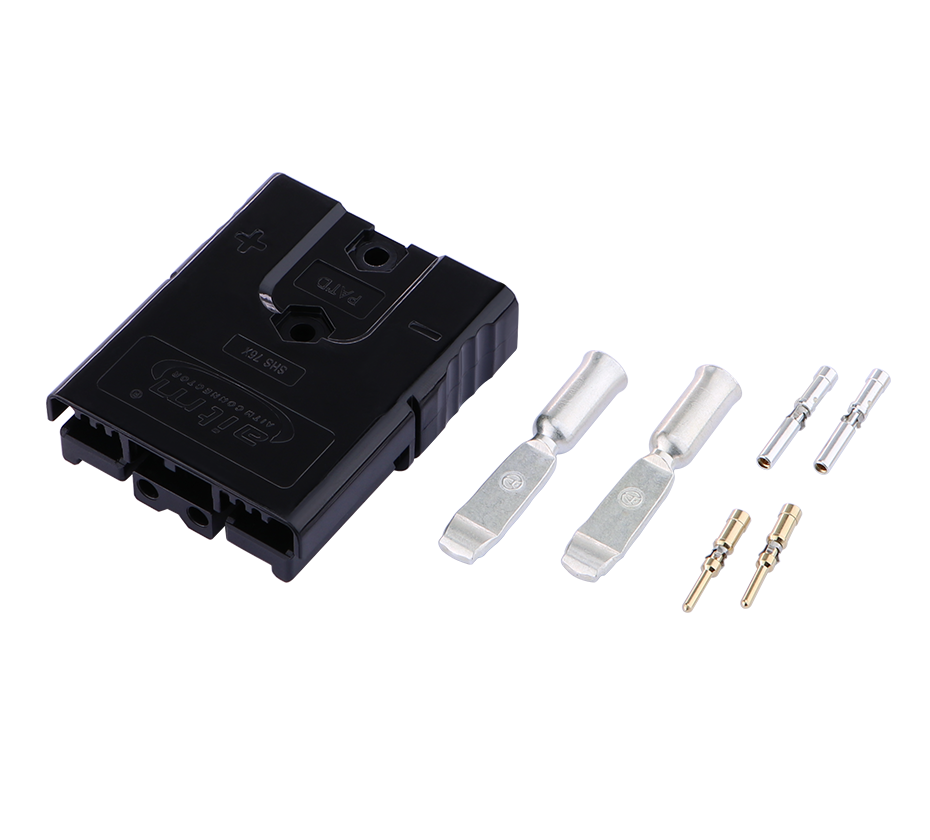
Molex Mini-Fit Jr.: The Workhorse of Internal Server Wiring
While EPS connectors handle the high-current CPU power path, the Molex Mini-Fit Jr. family serves as the primary interconnect for lower-power internal server wiring: peripheral devices, storage backplanes, fan trays, and auxiliary power distribution. The Mini-Fit Jr. system is optimized for high current, high density applications and is capable of handling up to 9.0A per circuit at a 4.2mm pitch, with configurations ranging from 2 to 24 circuits in single or dual-row arrangements.
The 24-pin ATX main power connector, which is commonly implemented using the Molex 5557 series (or equivalent), delivers power to the motherboard through a combination of +12V, +5V, and +3.3V rails. The 24-pin design, which superseded the earlier 20-pin version under the ATX 2.3 specification, expanded the +12V power supply channels from a single circuit to dual circuits, each supporting 10A, thereby increasing total power delivery capacity to 240W while providing independent 3.3V and 5V output lines for RAM, chipsets, and other low-voltage components. The connector features an anti-misinsertion latch design that prevents incorrect mating and provides audible confirmation of proper engagement.
For server applications, the Mini-Fit Jr. system is frequently specified with high-conductivity copper alloy contacts and selective gold plating on the mating interface. The fully isolated terminal design prevents accidental short circuits during assembly, while the scoop-proof housing protects contacts from damage during blind-mate operations. Polarization and keying features prevent mismating between different voltage circuits, a critical safety consideration in servers where a 12V connector must never be inserted into a 5V receptacle.
The Mini-Fit Jr. family has been widely adopted in rack-mount servers, routers, and switches because it balances current-carrying capacity with a compact footprint that suits the space constraints of 1U and 2U chassis. However, as server power demands have escalated, the limitations of the 9A-per-circuit rating have become apparent, driving the development of higher-density alternatives for main power paths while Mini-Fit Jr. remains the standard for auxiliary and peripheral connections.
High-Density Connectors for AI and Accelerated Computing
The emergence of AI training and inference workloads has fundamentally altered the power delivery landscape for servers. A single NVIDIA H100 GPU consumes up to 700W, and an 8-GPU server can draw 5.6 kW from the 12V bus alone—before accounting for CPU, memory, storage, and networking power. Rack-level power densities for AI clusters routinely exceed 50 kW, with some configurations approaching 150 kW. These demands have rendered traditional connector architectures insufficient and catalyzed the development of a new class of high-density, high-current power connectors.
TE Connectivity's MULTI-BEAM Plus connectors represent one response to this challenge. These connectors provide a maximum current of 140A per power contact, or 100A per contact when four adjacent contacts are loaded simultaneously. The design achieves this through thicker conductive material and a high-density tail configuration that carries higher current without increasing the connector's overall footprint. The scalable and modular architecture supports flexible configuration, allowing server designers to populate only the contacts required for a given power level, thereby optimizing both cost and PCB real estate. MULTI-BEAM Plus connectors share the same low-profile dimensions as earlier MULTI-BEAM generations—including MULTI-BEAM XL, XLE, and HD—ensuring backward compatibility and through-system airflow that has been validated in existing server chassis designs.
Amphenol's PwrBlade® Micro connector system addresses the same challenge from a cable-to-board perspective. The connector supports current ratings from 40A to 100A per contact (per four adjacent contacts) in a compact, low-profile form factor with stack heights ranging from 9mm to 26mm. The system incorporates Amphenol's proprietary silver-based GCS® plating technology, which provides superior conductivity and an ultra-low end-of-life contact resistance of 0.80 milliohms maximum. This low contact resistance is particularly important in high-current applications, where even small resistive losses can generate significant heat within the connector body. The pull-to-release latching mechanism with automatic snap-fit ensures secure retention while allowing field serviceability, and the connector is offered in right-angle and vertical orientations to accommodate diverse PCB layout requirements.
Molex's UltraWize wire-to-board connectors push the current density envelope further, delivering up to 170A of power per connector. The design employs COEUR socket technology with conical sockets that ensure a large conductive surface area, reducing voltage drop and contact resistance. A key architectural innovation is the cable-side exit configuration, which eliminates the cable-bend radius and reduces stack height—a critical consideration in 1U and 2U servers where vertical clearance is measured in millimeters. The staggered-pin design occupies less space on the PCB, leaving room for additional components or improved airflow paths.
For the most demanding power supply applications, TE Connectivity's high-density card edge connectors support 25A per contact with low resistance, enabling power supply units rated at 1500–2000W. These connectors are compliant with the Common Redundant Power Supply (CRPS) interface and are UL and TUV certified, providing the safety and reliability assurances required for enterprise deployments.
The 800V DC Transition and Its Connector Implications
The most significant architectural shift in data center power delivery is the transition from traditional 12V or 54V DC distribution within the rack to high-voltage DC (HVDC) architectures operating at 400V or 800V. This transition is driven by the fundamental physics of power transmission: at higher voltages, the same power can be delivered with proportionally lower current, which reduces resistive losses (P = I²R) and allows the use of smaller conductors.
NVIDIA has been a leading proponent of 800V DC rack-level power delivery, advocating for direct 800V DC distribution into the cabinet to replace the traditional 54V DC bus. In this architecture, 800V DC enters the computer room and is converted to 54V or 12V near the rack or within the power shelf, dramatically reducing the copper cross-section required for rack-level power distribution. TE Connectivity has demonstrated a liquid-cooled 800V busbar solution featuring an HVDC IT GEAR to ELCON MICRO+ power cable assembly rated at 800V and 75A on the high-voltage side, stepping down to 400V at the server connector interface.
The connector implications of this transition are profound. Connectors must be redesigned to withstand higher continuous voltages—800V DC places greater demands on insulation materials and creepage/clearance distances than 12V or 48V systems. Arc suppression becomes a critical design consideration, particularly for hot-plug and blind-mate applications where connectors may be mated or unmated under load. Thermal management at the connector interface becomes more challenging as current densities increase, necessitating liquid-cooled connector designs in some high-density configurations. The safety certification requirements for 800V connectors are also more stringent, with UL and IEC standards imposing specific requirements for dielectric withstand, partial discharge, and thermal cycling.
Standards and Certification
Server power connectors are governed by a layered framework of standards. The EPS specification, maintained by Intel, defines the electrical and mechanical requirements for CPU power connectors. The SSI (Server System Infrastructure) specifications, also developed with Intel leadership, cover power supply form factors, connector pinouts, and signal definitions for server platforms. The ATX specification, while primarily a desktop standard, continues to influence server design through its 24-pin main power connector and the 12VHPWR/12V-2x6 connectors for high-power PCIe devices.
For AC input connections, the IEC 320 C-14 inlet is the standard for server power supplies, rated at 15A/250VAC. This inlet accepts the ubiquitous C13 power cord and provides a reliable, standardized interface for facility power. DC power connectors for internal distribution are less formally standardized, with manufacturers developing proprietary solutions that meet the electrical and mechanical requirements of specific server platforms. However, the CRPS (Common Redundant Power Supply) initiative, led by Intel and supported by major server OEMs, has introduced standardized interfaces for hot-swap power supplies and their mating connectors.
Safety certification for server power connectors typically involves UL 1977 (Component Connectors for Use in Data, Signal, Control and Power Applications), UL 60950-1/62368-1 (Information Technology Equipment Safety), and equivalent IEC standards. The 12V-2x6 connector, introduced under the PCIe 5.1/ATX 3.1 specifications, represents a recent standardization effort to address the overheating issues observed with the original 12VHPWR connector. The 12V-2x6 maintains physical compatibility with 12VHPWR but optimizes pin alignment and contact geometry to reduce the risk of partial insertion and localized heating.
Server power connectors have evolved from simple pin-and-socket interfaces into sophisticated electromechanical systems that must satisfy competing demands for current density, thermal performance, mechanical reliability, and safety certification. The EPS 8-pin connector remains the backbone of CPU power delivery, while Mini-Fit Jr. and its derivatives handle auxiliary and peripheral power distribution. The AI computing era has driven the development of high-density connectors such as MULTI-BEAM Plus, PwrBlade Micro, and UltraWize, which deliver 100A to 170A per connector in form factors compatible with dense server chassis. The emerging 800V DC architecture will require yet another generation of connectors capable of operating at higher voltages with liquid-cooling compatibility and enhanced arc suppression. As rack power densities continue to climb, the connector will remain a critical—and increasingly visible—component in the data center power chain.
 Yang.taya@aitmpower.com
Tel: 15382891313
Phone: 0769-88878951
Fax: 0769-88878955
Wechat: 15382891313


 CN
 CN
 Home >