
 2026-10-14
 4
1. Introduction: The Connectivity Backbone of Modern Computing
High-density server connectors represent one of the most critical yet underappreciated components in modern data center infrastructure. As hyperscale data centers, artificial intelligence (AI) clusters, and high-performance computing (HPC) systems continue to push the boundaries of computational density, the interconnects that bind these systems together have evolved from simple passive components into sophisticated electromechanical systems that directly determine system performance, reliability, and thermal efficiency.
The fundamental challenge driving innovation in high-density server connectors is straightforward: more data must move faster through increasingly constrained physical spaces, all while consuming less power and generating less heat. This challenge has catalyzed the development of connector systems capable of supporting 224 Gbps PAM-4 signaling, ultra-low insertion loss, and exceptional crosstalk performance—all within form factors measured in millimeters .
2. The Evolution of Server Interconnect Requirements
2.1 From Gigabits to Terabits
The trajectory of server interconnect bandwidth has been nothing short of exponential. Where early 2000s servers operated with gigabit Ethernet connections and parallel SCSI storage interfaces, contemporary data center architectures demand per-lane signaling rates exceeding 50 Gbps PAM4, with next-generation systems targeting 224 Gbps per lane . This hundred-fold increase in signaling speed has fundamentally transformed every aspect of connector design.
The shift from NRZ (Non-Return-to-Zero) signaling to PAM4 (Pulse Amplitude Modulation with four levels) represented a watershed moment. PAM4 doubles the data rate for a given symbol rate by encoding two bits per symbol, but it also dramatically tightens the requirements for signal-to-noise ratio, insertion loss, and return loss . Connectors that performed adequately at 25 Gbps NRZ may prove entirely inadequate at 50 Gbps PAM4, necessitating complete redesigns rather than incremental improvements.
2.2 The Density Imperative
Moore‘s Law may be slowing in traditional semiconductor scaling, but the demand for computational density continues unabated. Modern hyperscale data centers measure their capacity in exaflops per rack, and achieving such densities requires every component—including connectors—to occupy minimal PCB real estate while delivering maximum performance.
The concept of “port density” has become a central metric for connector selection. Manufacturers now compete on how many high-speed channels can be packed into a given linear millimeter of PCB edge or square millimeter of board area . This density race has driven innovations in contact geometry, insulator materials, and shielding methodologies that would have seemed impossible just a decade ago.
3. Key Technical Parameters and Design Considerations
3.1 Data Rate and Signal Integrity
The headline specification for any high-density server connector is its maximum supported data rate, typically expressed in gigabits per second (Gbps) per lane or in aggregate bandwidth. Contemporary connectors span a wide performance spectrum, from mainstream solutions supporting 56 Gbps PAM4 to cutting-edge designs rated for 224 Gbps PAM-4 .
However, raw data rate tells only part of the story. Signal integrity (SI) performance encompasses a complex interplay of parameters including insertion loss, return loss, crosstalk (both near-end and far-end), and impedance consistency. At 224 Gbps PAM-4, the signal integrity requirements become extraordinarily demanding—insertion loss budgets may be measured in fractions of a decibel, and crosstalk must be suppressed to levels that would have been considered negligible at lower speeds .
The push toward higher speeds has also elevated the importance of impedance matching. While PCIe traditionally specified 85-ohm impedance for card electromechanical (CEM) interoperability, many high-speed server applications now offer 92-ohm and 95-ohm options that can provide superior insertion loss performance when CEM interoperability is not required . This impedance flexibility allows system architects to optimize SI for their specific channel characteristics rather than conforming to legacy standards.
3.2 Mechanical Reliability and Mating Cycles
A connector that delivers exceptional electrical performance but fails mechanically after a handful of mating cycles is of little value in data center environments where maintenance and upgrades are routine. High-density server connectors must balance electrical performance with mechanical robustness, addressing challenges including:
Mating Force and Retention: As contact counts increase and pitches shrink, managing insertion and extraction forces becomes increasingly challenging. Advanced connector designs employ features such as mechanical wipe interfaces, positive locking latches, and screw-based retention to ensure secure connections that resist vibration and accidental disconnection .
Alignment and Coplanarity Independence: Traditional connector systems often relied on PCB coplanarity and compression force to ensure proper mating. Modern near-ASIC connector designs decouple electrical performance from PCB mechanical tolerances, ensuring reliable connections even when coplanarity cannot be tightly controlled .
Durability: Connectors specified for data center applications typically must withstand hundreds or thousands of mating cycles without significant degradation. Contact plating materials (gold, palladium-nickel, silver), housing materials (high-temperature thermoplastics, LCP), and contact geometries all contribute to long-term reliability .
3.3 Thermal Management
Thermal considerations permeate every aspect of high-density connector design. Connectors must operate reliably at elevated temperatures while minimizing their contribution to system thermal load. Key thermal parameters include:
Current-Carrying Capacity: Power connectors must deliver substantial currents—often exceeding 100 amperes per contact—without excessive temperature rise. Contact resistance, cross-sectional area, and thermal conductivity of materials all influence current ratings .
Airflow Impact: Connector placement and profile affect system airflow. Low-profile designs that minimize obstruction to cooling air paths are increasingly preferred, particularly in dense server configurations where every cubic millimeter of airflow matters .
Thermal Cycling Reliability: Data center equipment experiences frequent thermal cycling as workloads fluctuate. Connectors must maintain electrical and mechanical integrity through thousands of temperature excursions between ambient and operating temperatures .
4. Major Connector Categories and Applications
4.1 Near-ASIC High-Speed Connectors
The most demanding server interconnect applications involve chip-to-chip or chip-to-I/O links operating at the highest available signaling rates. Near-ASIC connector systems, such as the Molex CX2-DS family, are specifically engineered for these applications .
These connectors employ twinax cable assemblies that can be routed directly from the ASIC package to front-panel I/O or across the midplane. The near-ASIC approach offers several advantages over traditional PCB trace routing: twinax cables provide superior signal integrity with lower loss and crosstalk than equivalent-length PCB traces, and they decouple the routing path from PCB design constraints, enabling more flexible system architectures .
CX2-DS connectors support 32 to 64 differential pairs, with data rates up to 224 Gbps PAM-4 at 92-ohm nominal impedance. The two-piece plug-and-receptacle construction ensures reliable mating independent of PCB coplanarity, while the screw-based retention system provides mechanical robustness suitable for high-vibration environments .
4.2 Storage and Peripheral Connectors
Server storage interfaces have undergone their own evolution, from parallel SCSI through SAS to NVMe over PCIe. High-density storage connectors must accommodate multi-lane signaling while maintaining signal integrity across cable assemblies and backplane connections.
The MCIO (Mini Cool Edge I/O) connector family, compliant with SNIA SFF-TA-1016 and PCIe Gen5 specifications, exemplifies modern storage interconnect design. These 0.60mm pitch connectors support up to 56 Gbps PAM4 per lane, with configurations ranging from 38 pins (4X) to 148 pins (20X) . Available in vertical and right-angle variants with 85-ohm and 92-ohm impedance options, MCIO connectors provide the flexibility required for diverse server and storage architectures .
Molex‘s iPass+ zHD connectors take a different approach to storage density, offering a vertical connector that nearly doubles port count compared to conventional iPass solutions. By eliminating midplane connections and providing direct cable-to-board mating, zHD connectors improve system airflow while maintaining signal integrity at 96 Gbps aggregate data rates .
4.3 Power Distribution Connectors
While signal connectors receive the majority of attention in high-speed design discussions, power connectors are equally critical to server functionality. Modern servers can draw kilowatts of power, and distributing that power efficiently to processors, GPUs, memory, and storage requires connector systems engineered for high current, low resistance, and minimal voltage drop.
Molex’s EXTreme Power product family illustrates the breadth of high-current connector solutions available. Products range from the EXTreme PowerEdge Plus card-edge connectors, rated for up to 47 amperes per 12 circuits, to the EXTreme EnergetiC connectors supporting 100 amperes per blade . These connectors serve applications including modular redundant power supplies, board-to-board power distribution, and rack-level power connections.
The Anderson Powerpole connector system represents a different philosophy in high-current connectivity. Powerpole connectors are genderless, allowing any two connectors to mate regardless of cable direction, and can be dovetailed together to create multi-pole configurations . The PP120 series supports up to 240 amperes per contact and 10,000 mating cycles, with optional hot-plug capability rated for 60 amperes . These characteristics make Powerpole connectors particularly suitable for UPS battery connections and rack-level power distribution where flexibility and reliability are paramount.
5. Materials and Manufacturing Technologies
5.1 Contact Materials and Plating
The electrical performance and reliability of any connector depend fundamentally on its contact system. High-density server connectors typically employ copper alloys (beryllium copper, phosphor bronze, or high-conductivity copper) for contact springs and bodies, selected for their combination of electrical conductivity, elastic properties, and formability.
Contact plating serves multiple functions: preventing oxidation and corrosion, providing a low-resistance interface, and extending wear life. Gold remains the gold standard (literally) for high-reliability applications, typically applied in thicknesses ranging from 0.5 to 2.0 micrometers over a nickel diffusion barrier. However, the cost of gold has driven interest in alternative plating systems, including palladium-nickel alloys and gold-flash over palladium-nickel .
5.2 Insulator Materials
The dielectric materials used in connector housings and wafers directly influence signal integrity through their dielectric constant and loss tangent. At 224 Gbps PAM-4, even small losses in the insulator can consume significant portions of the signal integrity budget.
Liquid Crystal Polymer (LCP) has emerged as the material of choice for high-speed connector insulators. LCP offers a favorable combination of low dielectric constant (approximately 3.0 at 10 GHz), low loss tangent (0.002-0.004), excellent dimensional stability, and compatibility with high-temperature soldering processes. Other high-performance thermoplastics, including polyphenylene sulfide (PPS) and polyetherimide (PEI), find use in applications where LCP’s properties are not required or where cost considerations dominate.
5.3 Shielding and Crosstalk Suppression
At multi-gigabit data rates, electromagnetic coupling between adjacent signal paths—crosstalk—can severely degrade signal integrity. High-density connectors employ multiple strategies to suppress crosstalk:
Ground plane integration: Many high-speed connectors incorporate ground contacts or ground planes between signal pairs, providing return current paths and electromagnetic shielding.
Conductive gaskets and housings: Shielded connector designs may employ conductive elastomer gaskets, metalized housings, or plated plastic components to create effective electromagnetic shields around signal pairs .
Differential pair routing: By routing signals as differential pairs and maintaining tight impedance control, connectors minimize common-mode noise and improve noise immunity.
Contact geometry: The physical arrangement of contacts—their spacing, orientation, and shielding—plays a critical role in determining crosstalk performance. Advanced connector designs optimize these parameters through electromagnetic simulation and iterative prototyping.
6. Standards and Interoperability
6.1 Industry Standards Organizations
High-density server connectors operate within a complex ecosystem of industry standards that ensure interoperability between components from different manufacturers. Key standards bodies include:
PCI-SIG: The PCI Special Interest Group maintains the PCI Express specification, including card electromechanical (CEM) requirements and connector form factors. PCIe Gen5 and Gen6 specifications define signaling requirements that connectors must support.
SNIA: The Storage Networking Industry Association develops specifications for storage form factors, including the SFF-TA-1002 and SFF-TA-1016 standards governing connectors used in EDSFF (Enterprise and Data Center Standard Form Factor) and related applications .
OCP: The Open Compute Project develops open-source hardware designs and specifications, including connector requirements for NIC 3.0 and other data center applications .
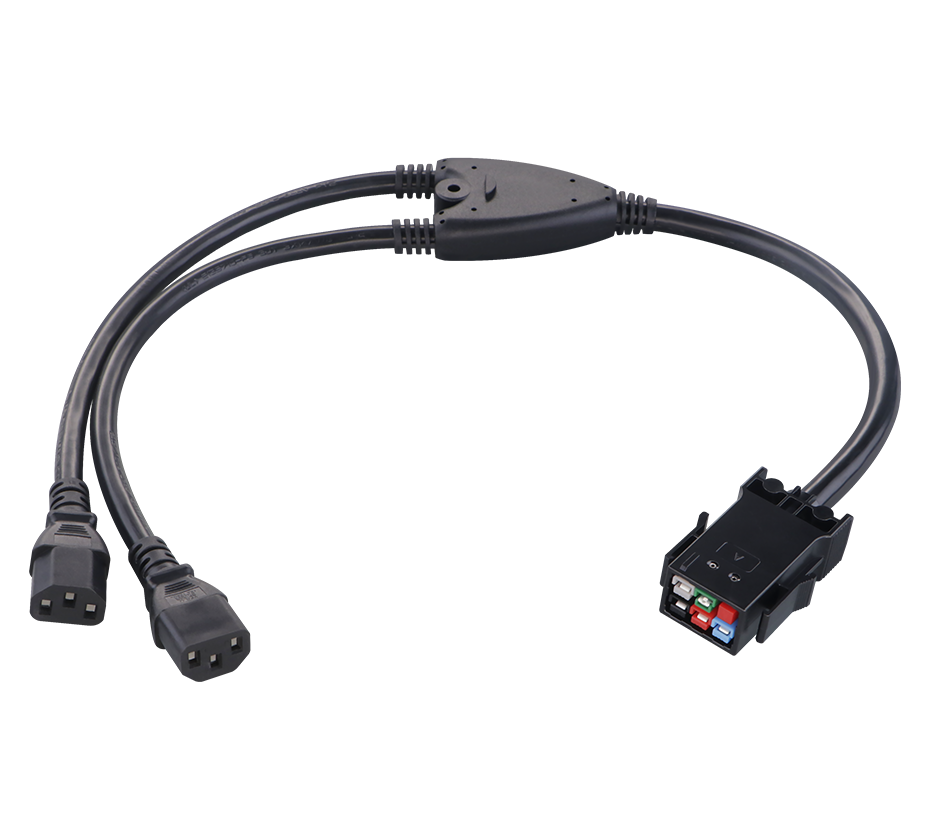
IEC: The International Electrotechnical Commission publishes standards for power connectors, including the IEC 60320 series governing appliance couplers used in UPS and PDU applications .
6.2 Impedance Standards and Interoperability
The question of impedance standardization versus optimization represents an ongoing tension in connector design. PCIe CEM specifications require 85-ohm impedance to ensure interoperability between cards and slots from different vendors. However, as noted in technical literature, 85 ohms is not an absolute requirement of the PCIe specification—it exists primarily to guarantee CEM interoperability .
Many high-speed server applications that do not require CEM interoperability can benefit from alternative impedances. A 92-ohm impedance can provide superior insertion loss performance compared to 85 ohms, while 95-ohm designs may offer further optimization for specific channel characteristics . Connector manufacturers increasingly offer products in multiple impedance options, allowing system designers to select the optimal impedance for their specific application.
7. Application-Specific Considerations
7.1 AI and Machine Learning Servers
AI and ML workloads present unique connectivity challenges. Training large models requires massive parallelism across GPUs or specialized accelerators, with high-bandwidth, low-latency interconnects between compute elements. The connector systems supporting these architectures must deliver exceptional signal integrity at the highest available data rates while maintaining the mechanical robustness required for dense, high-power configurations.
Near-ASIC connector solutions are particularly well-suited to AI server architectures. By routing twinax cables directly from accelerator packages, these connectors minimize the signal degradation associated with PCB routing while providing the flexibility to optimize cable lengths and routing paths for each specific system design .
7.2 Hyperscale Data Centers
Hyperscale data centers operate at a scale where even small improvements in connector performance or reliability translate into significant operational benefits. A connector that fails at even a fraction of a percent annually across millions of units creates substantial maintenance burdens, while a connector that consumes marginally less power per port can generate meaningful energy savings across an entire fleet.
This scale-driven focus on reliability and efficiency has driven hyperscale operators to develop their own connector specifications and qualification programs. The Open Compute Project and similar initiatives have emerged from this desire for standardized, reliable, and efficient components that can be sourced from multiple vendors .
7.3 Edge and 5G Deployments
While hyperscale data centers represent the most demanding connector applications in terms of absolute performance, edge computing and 5G infrastructure present their own challenges. Equipment deployed in these environments must often operate in wider temperature ranges, tolerate greater vibration, and fit within smaller enclosures than their data center counterparts.
Connector solutions for edge applications often prioritize ruggedness, wide temperature operation, and ease of field termination over the absolute highest data rates. However, as edge computing capabilities expand, the performance requirements for these connectors continue to rise, blurring the distinction between data center and edge interconnect specifications.
8. Future Directions and Emerging Technologies
8.1 448 Gbps and Beyond
The connector industry is already looking beyond 224 Gbps PAM-4 toward 448 Gbps signaling, which would likely employ PAM-6 or PAM-8 modulation or higher symbol rates. These future systems will demand connector performance that pushes the limits of current materials and manufacturing technologies, potentially requiring fundamental innovations in contact design, dielectric materials, and shielding methodologies.
8.2 Co-Packaged Optics and Optical Interconnects
The growing interest in co-packaged optics and silicon photonics may eventually shift some high-speed interconnect functions from electrical connectors to optical interfaces. However, optical interconnects bring their own connector challenges, including precision alignment requirements, thermal management of optical components, and the need for hybrid electrical-optical connector systems.
In the near term, optical interconnects are likely to complement rather than replace electrical connectors for most server applications. Electrical connectors will continue to handle power distribution, low-speed control signals, and short-reach high-speed links, while optical connections address longer-reach and higher-bandwidth applications.
8.3 Sustainable and Recyclable Connector Design
As the technology industry confronts its environmental impact, connector manufacturers are increasingly focusing on sustainability. This includes reducing or eliminating hazardous materials (such as beryllium copper, where alternatives exist), improving recyclability of connector materials, and designing for energy efficiency in both manufacturing and operation.
The push toward higher density and lower power consumption aligns well with sustainability goals, as more efficient connectors reduce overall system energy requirements. However, the use of exotic materials and complex manufacturing processes in high-performance connectors can offset these gains, creating a complex trade-off that the industry continues to navigate.
High-density server connectors have evolved from simple passive components into sophisticated engineering systems that directly enable the performance, reliability, and efficiency of modern data center infrastructure. The journey from gigabit to multi-hundred-gigabit signaling has required fundamental innovations in materials science, contact design, electromagnetic shielding, and manufacturing precision.
As the industry looks toward 448 Gbps signaling and beyond, connector designers face the challenge of maintaining the exponential bandwidth growth trajectory while managing increasingly stringent power, thermal, and cost constraints. The solutions that emerge will likely involve continued refinement of existing technologies alongside disruptive innovations in materials, manufacturing, and system architecture.
For system designers and data center operators, connector selection has become a strategic decision that impacts not only immediate system performance but also long-term scalability, maintainability, and operational cost. Understanding the technical parameters, trade-offs, and application-specific considerations discussed in this analysis provides a foundation for making informed connector choices in an ever-evolving technology landscape.
The high-density server connector may never receive the attention lavished on processors or accelerators, but its role in enabling the computational infrastructure of the modern world is no less essential. As data generation and processing continue their relentless growth, these precision-engineered components will remain the unsung backbone of the digital age.
 Yang.taya@aitmpower.com
Tel: 15382891313
Phone: 0769-88878951
Fax: 0769-88878955
Wechat: 15382891313


 CN
 CN
 Home >


