
 2026-10-14
 3
Introduction: The Unique Demands of UPS Battery Interfaces
Uninterruptible power supply (UPS) battery connectors occupy a distinct niche within the broader power connector landscape. Unlike server power connectors, which operate within the controlled environment of a data center rack, UPS battery connectors must function reliably in environments ranging from climate-controlled computer rooms to industrial facilities, telecommunications shelters, and outdoor cabinets. They must carry very high currents—often hundreds of amperes—at relatively low voltages (typically 12V, 24V, 48V, or 120V DC for battery strings), while maintaining extremely low contact resistance to minimize voltage drop and resistive heating. Above all, they must provide fail-safe connections that cannot be accidentally disconnected or reversed in polarity, because the consequences of a UPS battery disconnection during a power outage are the loss of critical loads and potential damage to equipment.
The UPS battery connector market is shaped by the same forces driving data center power infrastructure: the growth of cloud computing, the proliferation of edge facilities, and the increasing reliability requirements imposed by AI and high-availability applications. However, UPS battery connectors also serve markets well beyond IT, including telecommunications, industrial automation, healthcare, and transportation. This article examines the principal connector technologies used in UPS battery systems, the electrical and mechanical specifications that govern their selection, the safety standards that ensure their reliability, and the installation practices that determine their long-term performance.
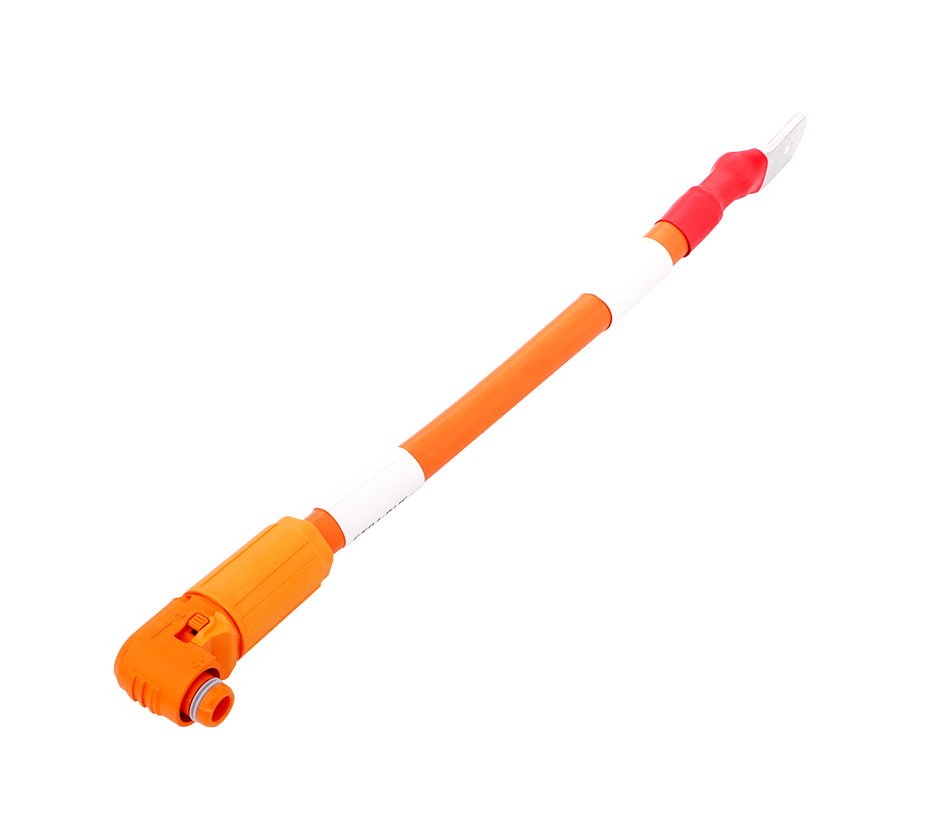
Anderson Power SB Series: The Industry Standard
The Anderson Power SB (SB standing for "Standard Block") connector series is the most widely recognized family of battery connectors in the UPS industry. Based on a design pioneered by Anderson Power Products in 1953, the two-pole SB connector established the standard for DC power distribution and battery connections that persists to the present day. The series ranges in size from the SB 50, rated for up to 50 amperes, to the SB 350, which can carry up to 500 amperes with 350 MCM cable.
The SB connector's defining characteristic is its genderless design. Unlike conventional plug-and-receptacle connectors, SB connectors are hermaphroditic: the two halves are identical, and flipping one 180 degrees allows it to mate with the other. This design reduces the customer's bill of materials by eliminating the need to stock separate plug and receptacle part numbers, and it simplifies field assembly because either half can serve as the line side or load side. The genderless design also provides economies of scale in manufacturing, as a single part number serves both mating halves.
The mechanical construction of the SB connector is equally distinctive. The housing is a rugged, one-piece plastic molding that resists impact damage and environmental exposure. Stainless steel springs retain the contacts and generate the contact force that produces the connector's exceptionally low resistance. Silver-plated contacts, standard across the SB series, minimize electrical resistance while offering superior durability and reliability. The combination of high contact force and silver plating yields a contact resistance measured in microohms, a critical parameter for high-current battery applications where even milliohm-level resistance can generate significant heat.
Color coding and mechanical keying are integral to the SB connector's safety architecture. Each family size offers color-coded, mechanically keyed housings designed to prevent both visually and physically cross-mating devices with different voltages. While all SB connectors are UL rated to 600 volts, the keys and colors serve as identifiers to prevent accidental interconnection of systems operating at different nominal voltages. For example, a 48V battery string and a 12V battery string would use differently keyed housings, making it physically impossible to mate a connector from one system to the other. This is a critical safety feature in UPS installations where multiple battery strings at different voltages may coexist in the same room.
The SB series is available in several standard sizes, each optimized for a particular current range. The SB 50 accommodates wire sizes up to 6 AWG (13.3 mm²) and is the smallest housing in the series, making it suitable for smaller UPS systems and battery backup units. The SB 175, the second-largest connector in the series, accepts wire sizes from 10 AWG to 1/0 AWG (5.3 mm² to 50 mm²) and is commonly used in medium-power UPS applications. The SB 350, the largest in the series, accommodates 1/0 MCM to 350 MCM wire (53.5 mm² to 185 mm²) and is specified for large three-phase UPS systems and battery strings carrying hundreds of amperes.
Popular SB applications extend well beyond UPS systems to include electrical testing equipment, commercial trucking chargers, automatic guided vehicles (AGVs), material handling equipment, motive power systems, and electric vehicles. This broad adoption across industries has created a robust ecosystem of compatible components, crimping tools, and mounting hardware that benefits UPS manufacturers and installers.
Battery Terminal Connectors: Lead-Acid and Beyond
While Anderson SB connectors are common for the DC output of UPS battery strings, the individual battery terminals—the points at which inter-cell and inter-string connections are made—use a different class of connector. For flooded lead-acid and valve-regulated lead-acid (VRLA) batteries, the standard terminal is a lead or lead-alloy post with a threaded insert or a bolt-through design. Connectors for these terminals are typically tin-plated copper lugs, compression lugs, or bolted busbar assemblies.
The National Electrical Manufacturers Association (NEMA) and the Battery Council International (BCI) define standard terminal configurations for lead-acid batteries, including the SAE post, the L-terminal, and the stud terminal. UPS battery strings, which often use 12V monobloc batteries connected in series to achieve the required DC bus voltage, typically employ bolt-on terminals with M6, M8, or M10 threaded inserts. The torque specification for these connections is critical: under-torquing results in high contact resistance and localized heating, while over-torquing can strip the threads or crack the lead terminal. Torque values vary by battery manufacturer and terminal size, with typical recommendations ranging from 5 to 15 Nm for M8 terminals and 8 to 20 Nm for M10 terminals. For larger UPS systems, the installation manual may specify a recommended torque of 10 Nm for all battery connections, with periodic retorquing required as part of preventive maintenance.
The choice of terminal hardware is equally important. Belleville washers (conical spring washers) are commonly specified for battery terminal connections because they maintain contact force over thermal cycling and compression set. The torque specifications for electrical connections with Belleville washers are typically lower than for flat washer connections, reflecting the spring washer's ability to compensate for relaxation of the joint. For example, a 1/4-inch bolt with a Belleville washer might be torqued to 46 lb-in (5.2 Nm), compared to 53 lb-in (6.0 Nm) for the same bolt with a standard flat washer.
Beyond lead-acid, lithium-ion battery systems are increasingly used in UPS applications, particularly for high-density data center deployments where floor space and weight are constrained. Lithium-ion UPS batteries typically use connector systems developed specifically for high-current DC applications, including busbar connections with bolted or compression interfaces, and pluggable connectors for modular battery packs. The connector requirements for lithium-ion systems are more demanding than for lead-acid because lithium-ion batteries can deliver very high fault currents, and the connector must be rated for the available short-circuit current without welding or arcing.
Safety Standards and Regulatory Framework
UPS battery connectors are subject to a comprehensive safety standards framework, with IEC 62040-1 being the primary international standard. This standard, titled "Uninterruptible power systems (UPS) – Part 1: General and safety requirements," specifies requirements for design, construction, and testing of UPS systems, including their battery connections. The current edition, BS EN IEC 62040-1:2019 with Amendment 2:2025, provides information relating to general test conditions, design requirements, wiring, connections and supply, and physical and electrical requirements.
IEC 62040-1 requires that disconnection devices for internal and external DC sources—including battery strings—must break all unearthed conductors connected to the DC source. This means that a UPS battery system must be equipped with a means of isolation that disconnects both the positive and negative conductors from the UPS, preventing any possibility of the battery continuing to supply power to the UPS or to ground during maintenance. The standard also requires that battery poles and connectors be accessible for retightening connections using appropriate tools, reflecting the reality that bolted battery connections can loosen over time due to thermal cycling and vibration.
The standard addresses wiring terminals for external power conductors in Section 6.3, specifying minimum and maximum cross-sections of copper conductors suitable for connection. This requirement ensures that the connector can safely accommodate the range of wire sizes likely to be used in a given UPS application, preventing the use of undersized conductors that could overheat or oversized conductors that might not make proper contact.
In the United States, UL 1778 (Uninterruptible Power Systems) is the applicable safety standard, harmonized with IEC 62040-1. UL 486A (Wire Connectors and Soldering Lugs) specifies requirements for the pressure wire connectors used to terminate battery cables. Connectors used in UPS battery systems must meet the requirements of UL 486A or a comparable standard recognized by a nationally recognized testing laboratory.
For the connectors themselves, UL 1977 (Component Connectors for Use in Data, Signal, Control and Power Applications) provides the component-level safety requirements. This standard covers the electrical, mechanical, and thermal performance of connectors, including temperature rise limits, dielectric withstand voltage, and mechanical endurance. Anderson SB connectors, for example, are UL rated to 600 volts, a rating that exceeds the voltage of most UPS battery strings but provides margin for transients and fault conditions.
The European Union's Low Voltage Directive (LVD) and Electromagnetic Compatibility (EMC) Directive apply to UPS systems and their components, requiring CE marking and compliance with harmonized standards. The Restriction of Hazardous Substances (RoHS) Directive restricts the use of lead, cadmium, mercury, and other hazardous materials in electrical and electronic equipment, which has driven the transition from lead-containing solder and platings to lead-free alternatives in connector manufacturing.
Installation Practices and Reliability Considerations
The reliability of UPS battery connectors depends as much on installation practices as on the inherent quality of the connector itself. Several factors are critical to achieving long-term, low-resistance connections.
Proper Crimping and Termination. For compression lugs and crimp-style connectors, the integrity of the crimp is the single most important determinant of connection reliability. A proper crimp creates a cold weld between the conductor strands and the connector barrel, producing a homogeneous metallic bond with negligible resistance. Improper crimping—using the wrong die size, insufficient compression force, or failing to insert the conductor fully into the barrel—creates a high-resistance joint that will overheat under load. Manufacturers specify the crimp tooling and die sets for each connector type, and these specifications should be strictly followed.
Torque Control. For bolted connections, torque is the primary means of ensuring adequate contact force. A calibrated torque wrench should always be used, and the torque value should be verified against the manufacturer's specification for the specific terminal and hardware configuration. As noted earlier, torque values for battery terminals typically range from 5 to 20 Nm depending on terminal size and material. The use of a torque marking compound or a paint stripe on the tightened connection provides a visual indication that the connection has been properly torqued and has not loosened over time.
Thermal Cycling and Retorquing. Battery connections are subject to repeated thermal cycling as the UPS charges and discharges the battery string. Each charge-discharge cycle causes the battery terminals and connector hardware to expand and contract at different rates, which can gradually reduce contact force and increase resistance. IEC 62040-1 recognizes this by requiring that battery poles and connectors be accessible for retightening. A schedule of periodic retorquing—typically annually for stationary UPS installations—is recommended to maintain connection integrity. Some manufacturers specify an initial torque value and a retorque value that differs by 5 lb-in or more, reflecting the relaxation that occurs after the first thermal cycle.
Contact Resistance Monitoring. In critical UPS installations, contact resistance can be monitored using a micro-ohmmeter or a thermal imaging camera. A sudden increase in contact resistance or an unexplained hot spot at a connector indicates a developing problem that should be corrected before it leads to failure. Infrared thermography is particularly useful because it can survey an entire battery string quickly and identify connections that are operating at elevated temperatures relative to their neighbors.
Environmental Considerations. UPS battery rooms can be hostile environments for connectors. Hydrogen gas evolved from flooded lead-acid batteries during charging creates an explosion risk if ventilation is inadequate, and the acidic electrolyte mist can corrode connector platings and hardware. Sealed VRLA and lithium-ion batteries eliminate the gas and acid concerns but introduce their own challenges, including higher operating temperatures and, for lithium-ion, the risk of thermal runaway. Connectors specified for UPS battery applications should have platings and housing materials that resist the specific environmental conditions of the installation, whether that is a climate-controlled data center, an unheated telecommunications shelter, or an industrial facility with airborne contaminants.
Emerging Trends in UPS Battery Connectors
Several trends are reshaping the UPS battery connector landscape.
Modular Battery Systems. The shift from monolithic battery strings to modular, hot-swappable battery packs is changing connector requirements. Modular systems require connectors that can be safely mated and unmated under load, which imposes arc suppression and touch-safe design requirements. Pluggable connectors with sequential mating—where ground and sense contacts mate before power contacts—are increasingly common in modular UPS architectures.
Lithium-Ion Adoption. As lithium-ion batteries become more cost-competitive with lead-acid for UPS applications, connector designs are evolving to meet the higher fault current and different thermal characteristics of lithium-ion cells. Connectors for lithium-ion UPS batteries may include integrated temperature sensors, cell balancing contacts, and communication interfaces for battery management systems.
Higher DC Bus Voltages. While most UPS battery strings operate at 12V, 24V, or 48V, higher-voltage battery systems (120V, 240V, and even 400V DC) are being deployed to reduce conductor sizes and improve efficiency. Higher voltages impose more stringent requirements on connector insulation, creepage distance, and arc suppression, driving the development of new connector families rated for these applications.
Predictive Maintenance and Smart Connectors. The integration of sensors into connectors—temperature sensors, current sensors, and contact resistance monitors—enables predictive maintenance, where the connector itself reports its condition to a monitoring system. This capability is particularly valuable in large UPS installations where manual inspection of hundreds of connections is impractical.
UPS battery connectors are a critical but often overlooked component of power infrastructure. The Anderson Power SB series, with its genderless design, rugged construction, and broad current range, has set the standard for DC battery connections for over seven decades. Lead-acid battery terminal connectors, governed by torque specifications and safety standards, ensure reliable connections at the cell and string level. The IEC 62040-1 safety standard and its national counterparts provide the regulatory framework that ensures UPS battery connections are designed, installed, and maintained to protect both equipment and personnel. As UPS systems evolve toward modular architectures, lithium-ion batteries, and higher DC bus voltages, connector technology will continue to advance, balancing the competing demands of current capacity, safety, and serviceability. The fundamental principle remains unchanged: a UPS is only as reliable as its weakest connection, and the battery connector is too often that weak link.
 Yang.taya@aitmpower.com
Tel: 15382891313
Phone: 0769-88878951
Fax: 0769-88878955
Wechat: 15382891313


 CN
 CN
 Home >