
 2026-10-14
 2
The forklift battery pack connector serves as the critical electrical and mechanical interface between a forklift's traction battery and its power system. As material handling equipment undergoes a profound transformation from lead-acid to lithium-ion power sources, the design, performance, and reliability requirements for these connectors have intensified dramatically. This article provides an in-depth examination of forklift battery pack connectors, covering their fundamental architecture, electrical characteristics, material science, safety standards, application environments, and emerging technological trends. It explores the connector types commonly deployed in industrial settings—including the Anderson SB series, DIN standard connectors, and the latest generation of modular designs—and analyzes how each addresses the unique demands of high-current, high-cycle industrial operations. The discussion also considers the impact of international safety standards such as EN 1175, DIN VDE 0623-589, and IEC 62485 on connector design and selection, and examines the growing market for these components as global electrification accelerates.
1.Overview
The electric forklift has become the workhorse of modern warehouses, distribution centers, and manufacturing facilities. At the heart of every electric forklift lies a traction battery that must be reliably connected to the vehicle's power system through a robust, high-current connector. The forklift battery pack connector—sometimes referred to as a battery plug, battery coupler, or traction battery connector—is far more than a simple plug-and-socket arrangement. It is a precision-engineered component that must safely conduct currents ranging from 50 to over 500 amperes, withstand tens of thousands of mating cycles, resist acid and environmental degradation, and provide reliable performance in some of the most demanding industrial environments imaginable.
The global shift from lead-acid to lithium-ion battery technology has placed new and unprecedented demands on battery pack connectors. Fast charging generates significantly more heat, outdoor charging requires ingress protection, and advanced battery management systems necessitate signal and communication contacts within the connector assembly. Simultaneously, the rapid expansion of e-commerce and omni-channel retail has increased the pressure on material handling operations to minimize downtime, making quick-change battery connector systems an essential element of fleet management strategy.
This article aims to provide a comprehensive technical and contextual analysis of forklift battery pack connectors. It begins by examining the fundamental architecture and electrical characteristics of these components, then explores the major connector families in use today, evaluates material and construction considerations, reviews applicable safety standards, analyzes application environments, and finally surveys emerging trends and market dynamics shaping the future of this critical interface technology.
2. Fundamental Architecture and Design Principles
2.1 Core Components
A forklift battery pack connector typically comprises several precision-engineered components that work in concert to deliver safe, efficient power transmission. The primary elements include the housing or shell, which provides mechanical protection and electrical insulation; the contact terminals, which carry the actual current; the retention mechanism, which ensures the connector remains mated during operation; and often an auxiliary contact system for signal transmission or battery monitoring.
The housing is commonly constructed from engineering-grade thermoplastics such as polycarbonate (PC) or PC/PBT blends. These materials must satisfy stringent flammability requirements, typically achieving UL94 V-0 classification, meaning they self-extinguish within ten seconds of removal from a flame source. The housing also serves as the primary defense against environmental hazards, with many designs incorporating sealing elements to achieve IP ratings suitable for outdoor and washdown environments.
Contact terminals are almost universally manufactured from copper and plated with silver. Silver plating serves multiple critical functions: it provides extremely low contact resistance (often less than 500 micro-ohms), resists oxidation, and offers a self-cleaning property during mating and unmating cycles. The dynamic sliding action that occurs during disconnection mechanically removes surface contaminants from the terminal interface, ensuring consistently efficient power transmission over the connector's service life.
2.2 Electrical Characteristics
Forklift battery pack connectors are engineered to handle a wide range of electrical loads. In the current market, common current ratings span from 50A to 350A, with some specialized connectors accommodating up to 500A for high-performance fast-charging applications. Working voltages are typically rated at 600V DC, though actual operating voltages in forklift applications generally range from 24V to 96V, with higher-voltage architectures emerging for larger equipment.
The relationship between current and thermal performance is governed by Joule's Law, which states that resistive heat generation is proportional to the square of the current (P = I²R). This fundamental principle explains why higher-current connectors must employ larger contact surfaces, superior materials, and often active thermal management features to prevent overheating. Connector manufacturers publish derating curves that specify the maximum allowable current as a function of ambient temperature, enabling system designers to select connectors appropriately for their specific operating conditions.
Contact resistance is a critical performance parameter. Values typically range from 25 to 500 micro-ohms depending on the connector size and design. Low contact resistance minimizes voltage drop and heat generation, improving overall system efficiency and extending connector life. The retention force—the mechanical force required to separate mated connectors—ranges from approximately 150N for 160A connectors to over 210N for 320A variants, ensuring secure connections even under vibration.
3. Major Connector Types and Families
3.1 Anderson SB Series
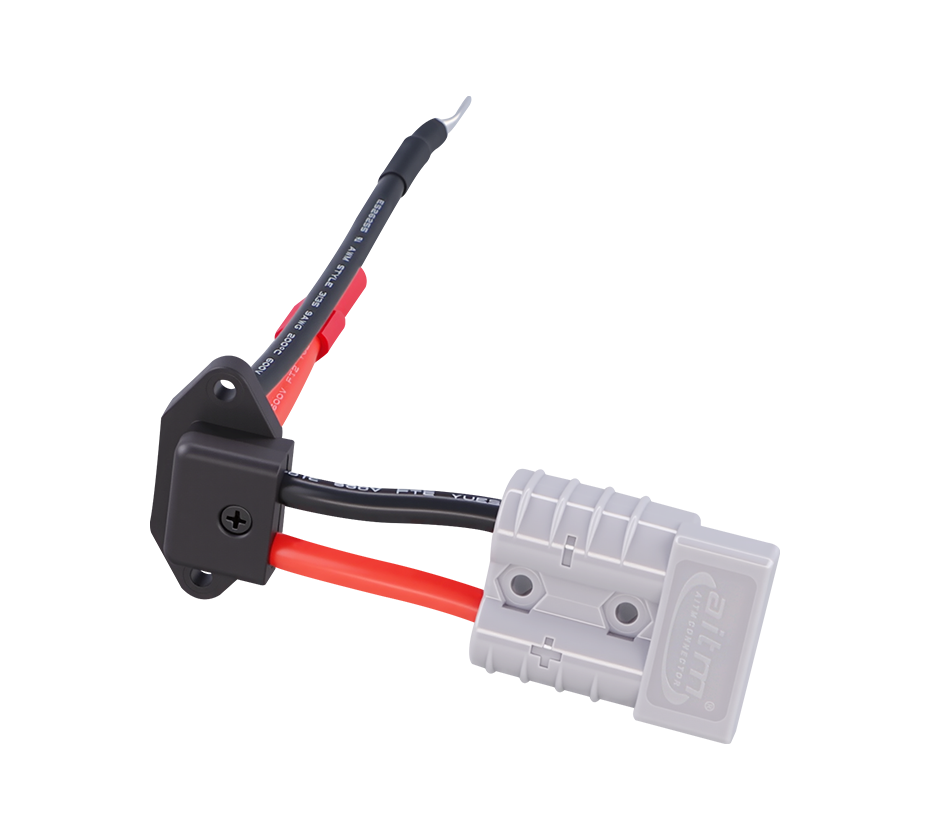
The Anderson SB (Standard Battery) series is perhaps the most widely recognized family of battery connectors in the material handling industry. Originally developed by Anderson Power Products, the SB series has become something of a generic term, with many manufacturers producing compatible designs.
The SB series encompasses a range of sizes designed to accommodate different wire gauges and current requirements. The SB 50, the smallest in the series, accepts wire sizes from 16 AWG to 6 AWG and is rated for currents up to approximately 50A. It features a one-piece plastic housing using stainless steel springs to maintain low-resistance contact pressure. The SB 175 represents a mid-range option, accepting wire sizes from 10 AWG to 1/0 AWG and rated for UL currents up to 280A. At the top of the standard range, the SB 350 is the workhorse connector for sit-down and stand-up counterbalance forklifts, handling currents up to 350A and accepting wire sizes up to 4/0 AWG.
A defining characteristic of the SB series is its genderless design. Both halves of the connector are identical, eliminating the need to distinguish between plug and socket and significantly simplifying inventory management. The connectors feature mechanical keying and color coding to prevent accidental cross-mating of different voltage systems.
3.2 DIN Standard Connectors
DIN standard battery connectors, particularly those conforming to DIN 43589-1 and the related DIN VDE 0623-589, represent the other major connector family in the European forklift market. Unlike the genderless SB design, DIN connectors are typically configured as male (plug) and female (socket) pairs with polarized terminals that prevent reverse connection.
DIN connectors are available in 80A, 160A, and 320A configurations, with the 160A and 320A versions being most common for counterbalance forklift applications. They feature robust, acid-resistant housings and incorporate auxiliary contacts for battery monitoring or charger communication. The connectors are designed with cable strain relief and locking mechanisms to maintain secure connections in high-vibration environments.
A significant advantage of DIN connectors is their comprehensive standardization, which ensures interchangeability across different equipment manufacturers. This standardization has made DIN connectors the preferred choice in European warehousing and logistics operations where fleet interoperability is essential.
3.3 Rema Connectors
Rema is a prominent manufacturer of DIN-compliant battery connectors, offering a comprehensive range that includes the EC (Electric Connector) series. Rema connectors are known for their acid-resistant construction, with housings typically made from PC-PBT blends rated UL94 V-0. The Rema product line spans 80A, 160A, and 320A configurations, with optional features such as pilot contacts for battery management systems, integrated cable clamps for strain relief, and color-coded coding pins for voltage identification.
The Rema connector design emphasizes hot-swappable capability, allowing connections to be made and broken under load without interrupting current flow—a critical feature for operations that cannot afford downtime during battery changes. The female terminals are specifically designed to prevent accidental contact with live contacts, reducing the risk of electrical shock during maintenance operations.
3.4 Emerging Modular Designs
The latest generation of forklift battery connectors incorporates modular, cartridge-based architectures that represent a significant departure from traditional monolithic designs. Anderson Power's Industrial Battery Connector (IBC) series exemplifies this trend, featuring a patent-pending modular design in which the contact cartridge can be easily removed and replaced without disassembling the entire connector.
The IBC series is available in 80A, 160A, and 320A platforms, with the 320A and 160A versions offering industry-leading signal options—up to 10 auxiliary contacts for the 320A variant. This modular approach enables tool-less contact repair or replacement, simplifies connector maintenance, and reduces the number of spare parts that must be stocked. The connectors are designed to meet EN 1175, RoHS, and DIN VDE 0623-589 standards, and are available with IP68-rated sealing kits for outdoor applications.
4. Materials and Construction
4.1 Housing Materials
The connector housing must satisfy a demanding combination of requirements: electrical insulation, mechanical strength, thermal stability, chemical resistance (particularly to sulfuric acid in lead-acid battery environments), and flame retardancy. Polycarbonate (PC) is the most commonly used material, often blended with polybutylene terephthalate (PBT) to enhance thermal and chemical resistance.
The UL94 V-0 flammability rating is essentially mandatory for forklift battery connectors. This rating indicates that the material self-extinguishes within ten seconds when the flame source is removed, and that burning drips will not ignite cotton placed below the specimen. Some designs also incorporate Bakelite (phenolic) housings, which offer excellent heat resistance and dimensional stability, albeit at higher weight and cost.
4.2 Contact Materials
Copper is universally used as the base material for contact terminals due to its excellent electrical conductivity. However, bare copper rapidly oxidizes, forming a resistive surface layer that degrades performance. Silver plating addresses this problem, providing a stable, low-resistance interface that maintains performance over thousands of mating cycles.
The plating thickness and quality are critical parameters. High-quality connectors typically employ silver plating of 3 to 5 microns on copper contacts, with some premium designs using silver alloys for enhanced wear resistance. The self-cleaning action during mating and unmating helps maintain the integrity of the silver surface, but eventually the plating wears through, necessitating connector replacement after a defined number of cycles.
4.3 Sealing and Environmental Protection
Industrial environments expose connectors to a wide range of hazards: dust, moisture, battery acid, hydraulic fluid, and temperature extremes. Sealing elements—typically silicone or EPDM O-rings and gaskets—protect the internal contact surfaces from contamination. The IP (Ingress Protection) rating system quantifies this protection, with IP23 being common for basic connectors and IP68 representing the highest level of dust and water resistance.
5. Safety Standards and Regulatory Compliance
5.1 EN 1175
EN 1175 is the European standard for the safety of industrial trucks, and it has significant implications for battery connector design. The 2025 revision of this standard represents a paradigm shift in how connectors are evaluated, moving from a component-level approach to a system-level perspective. The updated standard recognizes that a connector's thermal performance cannot be assessed in isolation but must be considered within the context of the entire charging system, including the battery, charger, and cable assembly.
Key requirements of EN 1175 relevant to connectors include thermal management provisions to prevent overheating during fast charging, acid resistance for lead-acid battery environments, and mechanical robustness to withstand the rigors of industrial operation. Connectors must be tested under conditions that simulate the full range of ambient temperatures and operational loads they may encounter in service.
5.2 DIN VDE 0623-589
DIN VDE 0623-589 is the German standard specifically governing battery connectors for industrial trucks. It defines the dimensional, electrical, and mechanical requirements for DIN-style connectors, ensuring interchangeability across different manufacturers. The standard specifies contact arrangements, housing dimensions, coding provisions, and performance test procedures.
5.3 IEC 62485
IEC 62485 addresses the safety requirements for secondary batteries and battery installations. Part 6 of this standard, IEC 62485-6:2021, specifically addresses lithium-ion battery installations in traction applications, including industrial forklifts. It mandates that cables and connectors be properly insulated to prevent short circuits and provides requirements for overcurrent protection where applicable.
5.4 IEC 62619
IEC 62619 specifies requirements and tests for the safe operation of secondary lithium cells and batteries used in industrial applications, including forklift trucks. The standard includes a specific test for external short circuits: terminals are shorted through low resistance, and the surface temperature must not exceed 150°C. This requirement directly influences connector design, particularly in terms of contact resistance and thermal mass.
6. Application Environments and Operational Considerations
6.1 Warehousing and Logistics
Warehousing and logistics operations represent the largest application segment for forklift battery connectors. These environments are characterized by high-throughput operations, multi-shift schedules, and stringent uptime requirements. Quick-change battery connectors enable battery swaps in minutes rather than hours, allowing operations to maintain continuous workflow without the extended charging downtime associated with opportunity charging strategies.
In these environments, connectors must withstand frequent mating cycles—often multiple times per day per vehicle—and resist the dust, debris, and occasional impacts that are inevitable in busy warehouse settings.
6.2 Cold Storage and Outdoor Applications
Forklift operations in cold storage facilities and outdoor yards expose battery connectors to temperature extremes. Cold storage environments can reach -30°C, while outdoor operations in summer may encounter ambient temperatures exceeding 40°C. Connectors must maintain flexibility and sealing integrity across this range, which typically requires specialized elastomer formulations for the sealing elements and careful material selection for the housing.
The growth of outdoor charging infrastructure has further intensified the need for robust sealing. Connectors used in outdoor charging stations must achieve IP67 or IP68 ratings to prevent moisture ingress during rain or washdown.
6.3 Maintenance and Inspection Practices
Proper maintenance is essential for connector reliability and safety. Best practices include regular cleaning of terminal pins to maintain good conductivity, inspection of the connector shell for cracks, discoloration, or signs of melting, and verification that crimp connections remain secure. Connectors that show evidence of overheating—discolored or melted housing material—should be replaced immediately, as thermal damage indicates degraded contact resistance that will only worsen with continued use.
7. Emerging Trends and Future Directions
7.1 Lithium-Ion Transition and Thermal Management
The ongoing transition from lead-acid to lithium-ion battery technology represents the most significant force reshaping connector requirements. Lithium-ion batteries offer higher energy density, longer cycle life, and faster charging capability, but these advantages come with new thermal challenges. Fast charging generates substantially more heat at the connector interface, making thermal durability a critical design consideration.
Connector manufacturers are responding with integrated temperature sensing solutions. Negative Temperature Coefficient (NTC) sensors embedded in the connector assembly enable real-time monitoring of contact temperature, allowing charging systems to dynamically reduce current when safe thresholds are approached. This technology enables faster charging without compromising safety, a critical capability for high-demand operations.
7.2 Modular and Configurable Architectures
The trend toward modular connector designs reflects a broader shift in industrial component philosophy toward flexibility and serviceability. Modular connectors allow users to configure the number of power and signal contacts to match their specific requirements, and to replace individual cartridges rather than the entire connector when maintenance is needed.
This approach offers significant advantages in terms of inventory management, maintenance costs, and system scalability. A single housing platform can accommodate multiple configurations, reducing the number of spare parts that must be stocked and enabling field upgrades as system requirements evolve.
7.3 Market Growth and Industry Outlook
The market for forklift battery connectors is experiencing robust growth, driven by the global electrification of material handling equipment. The quick-change battery connectors market for material handling equipment was valued at $1.2 billion in 2024 and is projected to reach $2.7 billion by 2033, representing a compound annual growth rate of 9.8%. The broader high-current connectors market for industrial vehicles is even larger, estimated at $3.28 billion in 2025 and projected to expand to $6.88 billion by 2034.
This growth is driven by multiple factors: the continued electrification of forklift fleets, the expansion of e-commerce and omni-channel retail, government incentives for energy-efficient equipment, and stricter emissions regulations that favor electric over internal combustion engine vehicles.
The forklift battery pack connector is a critical enabling component of electric material handling operations. From its humble beginnings as a simple plug-and-socket arrangement, the connector has evolved into a sophisticated engineering assembly capable of handling hundreds of amperes, thousands of mating cycles, and the full range of environmental hazards present in industrial environments.
The transition to lithium-ion technology, the growth of fast and opportunity charging, and the expansion of outdoor charging infrastructure are driving continued innovation in connector design. Modular architectures, integrated thermal sensing, enhanced sealing, and extended signal capabilities represent the current state of the art, but the pace of technological change shows no sign of slowing.
For fleet operators and maintenance professionals, understanding the technical characteristics of battery pack connectors and adhering to proper maintenance practices are essential for ensuring safety, maximizing uptime, and controlling total cost of ownership. As the material handling industry continues its inexorable shift toward electrification and automation, the battery pack connector will remain a critical component in the power delivery chain, silently enabling the movement of goods that underpins modern commerce.
 Yang.taya@aitmpower.com
Tel: 15382891313
Phone: 0769-88878951
Fax: 0769-88878955
Wechat: 15382891313


 CN
 CN
 Home >